Build from
anywhere.
An asynchronous mobile gateway that converts developer intent into production repository-level code commits using persistent cloud AI agents.
AI coding agents are powerful.Their interfaces are still desktop-first.
Desktop Dependency
Most agentic development workflows assume a persistent desktop, terminal, IDE, and local development environment.
Mobile Constraints
Traditional IDEs become difficult to operate on small, touch-based mobile interfaces.
Network Instability
Remote desktop and continuous browser sessions degrade when mobile connectivity becomes unstable.
The core limitation isn't compute.
It's access.
The Resource Interface Duality
The best device for interacting with an AI agent is not necessarily the best device for executing its work.
Mobile Device
Cloud Runtime
One gateway. Four core responsibilities.
Asynchronous Execution
Requests become persistent Redis jobs. The mobile browser does not need to remain connected while an AI agent works autonomously on the cloud host.
Persistent AI Runtime
The cloud executor remains available 24/7 independently of the developer's workstation or smartphone connection.
Work directly with Git.
Native version control workflow without exposing local uncommitted state.
Control plane, zero editing.
High-level intent inputs optimized for touch viewports.
Three independent layers.
Interaction, orchestration, and execution remain logically separated.
Developer interaction without a mobile IDE.
The mobile client focuses on repository selection, high-level prompts, approvals, task monitoring, logs, and deployment state. Heavy development operations never execute on the phone.
What actually happens?
Mobile Prompt Capture & Intent Parsing
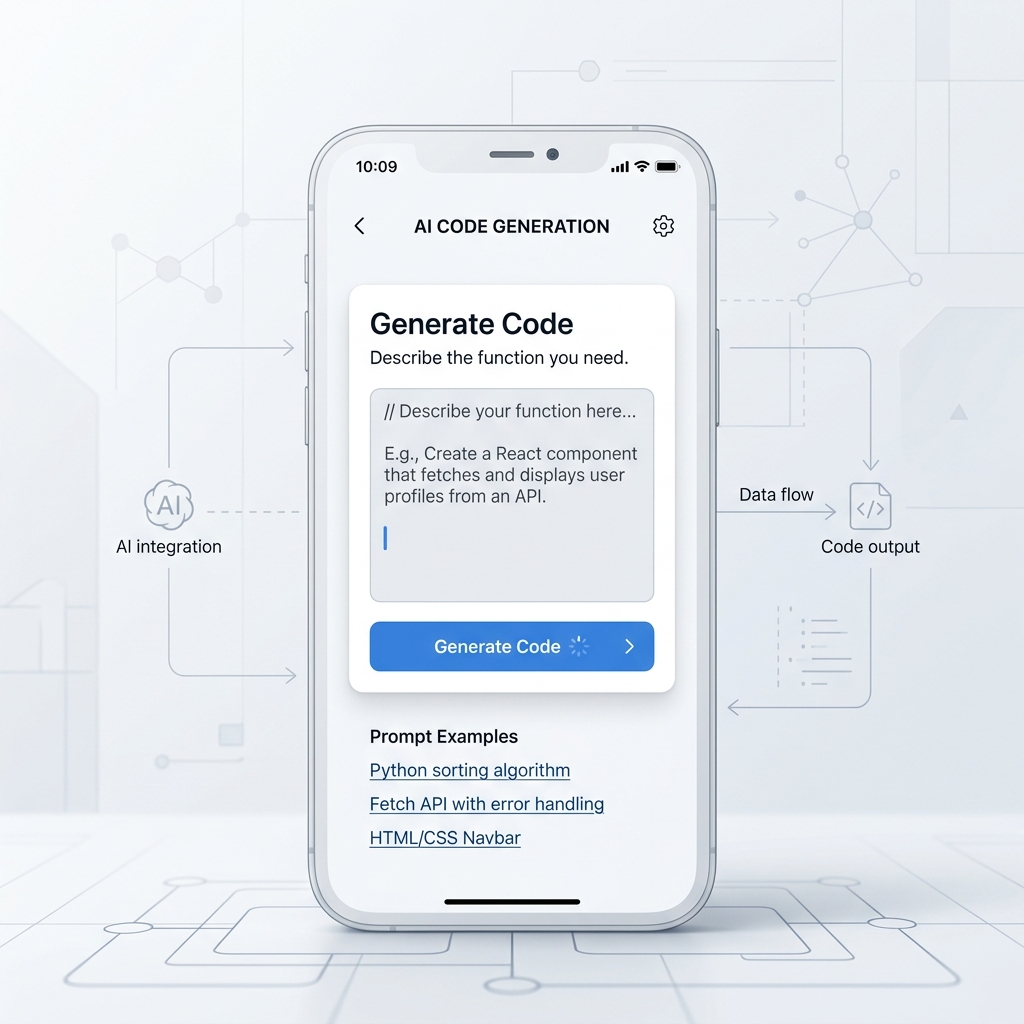
The developer submits a high-level intent prompt from any mobile browser. The request is structured into a normalized JSON payload containing repository target, branch name, prompt directives, and authorization signatures without triggering local compilation.
Why not just use Remote Desktop?
From one mobile prompt to production.
“Add an analytics dashboard to the admin panel using Tailwind and the project's existing data hooks.”
What happens when the phone disconnects?
Nothing happens to the execution job. The phone acts as a control interface, not the runtime. When connectivity returns, the client retrieves the latest persisted task state seamlessly.
Automation without sacrificing control.
OAuth Authentication
Repository access is strictly linked to verified PKCE developer credentials.
Isolated Workspaces
Tasks execute inside ephemeral Docker containers without host exposure.
Secret Management
Sensitive API keys remain server-side and never reach the mobile browser.
Approval Gates
High-impact branch pushes and deployments require explicit mobile confirmation.
Built as a system.
Production-grade tools powering client interaction, persistent orchestration, agentic AI, and continuous delivery.
 Next.js 16
 TypeScript
 Tailwind CSS
 Supabase BaaS
 PostgreSQL
 GitHub OAuth
 Redis Queue
 Node.js Daemon
 Docker Sandbox
 OpenRouter AI
 Google Gemini
 Anthropic Claude
 Git Engine
 Vercel CI/CD
 WhatsApp Alerts
Research foundation.
State-of-the-art foundation research powering autonomous multi-agent systems and cloud runtimes.
SWE-agent: Agent-Computer Interfaces Enable Automated Software Engineering
Introduces Agent-Computer Interfaces (ACIs) tailored for LLMs, demonstrating that simplified commands outperform raw terminal shell access.
SWE-bench: Can Language Models Resolve Real-World GitHub Issues?
Defines the standard benchmark suite for evaluating repository-level issue resolution using real GitHub pull requests.
OpenHands: An Open Platform for AI Software Developers as Generalist Agents
Proposes an open platform for autonomous software agents executing inside sandboxed container runtimes.
MetaGPT: Meta Programming for A Multi-Agent Collaborative Framework
Encodes Standard Operating Procedures (SOPs) into multi-agent prompt flows to generate structured code outputs.
ChatDev: Communicative Agents for Software Development
Demonstrates multi-agent chat chains for collaborative software design, coding, and automated debugging.
SWE-World: Docker-Free Execution Environments for Agent Evaluation
Develops surrogate execution feedback models to eliminate container instantiation overhead during evaluation loops.
SWE-Adept: Agentic Traversal and Structured Resolution for Repository Issues
Proposes depth-first dependency traversal and shared memory checkpoints for precise issue localization.
Open-SWE-Traces: Advancing Dual-Mode Distillation for Software Agents
Releases expansive multi-language agentic trajectory datasets for fine-tuning long-horizon software reasoning.
SWE-EVO: Benchmarking Autonomous Software Evolution
Evaluates multi-step release-sized software modifications across large versioned Python codebases.
RepoAudit: Autonomous LLM-Agent for Repository-Level Code Auditing
Explores autonomous code auditing, static analysis, and bug detection in large repository structures.
Microservices-Based Scalable Architectures for AI-Driven Systems in Cloud
Establishes design patterns for decoupling AI inference services using microservices and Redis caching.
Lightweight Mobile Cloud Computing Environment for Mobile Applications
Investigates resource offloading frameworks from mobile terminals to cloud-assisted backend gateways.
Workflow Management and Scheduling in a Cloud Computing Context
Evaluates asynchronous message queues and elastic computing for workflow scheduling and batch processing.
Real-Time Collaboration Architecture via WebSocket Protocols
Details persistent, low-latency WebSocket connection handling for real-time bidirectional data exchange.
Microservices Best Practices and Asynchronous Communication
Compares synchronous HTTP REST vs. asynchronous message queue protocols in distributed cloud gateways.
12 weeks from concept to validation.
Four structured phases delivering infrastructure, real-time transport, agentic execution, and empirical testing.
Foundation
Communication
Intelligence
Validation
How will we know it actually works?
The project is evaluated using measurable system outcomes and objective benchmark metrics, not only a manual demonstration.
Development shouldn't stopwhen the laptop closes.
A mobile-first control plane for persistent AI software engineering agents — review diffs, approve pushes, and monitor builds anytime, anywhere.